欢迎来到中国内燃机学会

  • 论文全文 - 第27届CIMAC会议 未指定分类
    论文已在中国上海举行的第27届CIMAC大会上发表。论文的版权归CIMAC所有。Future trends in engine design go towards higher firing pressures, which further increasethe tribo-mechanical loading of journal bearing systems to an extent that requires fundamentally new approaches. One of the most important goals in latest research activities is the active use of tribochemical effects of lubricants in journal bearing systems. Positive chemical effects of extreme pressure and anti-wear additives, such as ZDD have been already well researched in the field of gear and valve train systemsover the last decades. For the first time, it was shownthat tribofilms can also form in journal bearing systems, which influence the tribological behaviour significantly. In case of Al-based bearing material, which is rather inert to tribochemical reactions, tribofilms form-ing on the mating steel counterpart increase the load bearing capacity and also the wear resistance.This fact is due to the lubricity the softer tribofilms impose on the harder steel counterpart.The response of Al-based materials towards film formation is effectively improved by adding selected intermetallic hard phases.The research activities further elucidate a synergistic effect between the design of the bearingmaterials and the employed lubricant formulation.The results obtained so far clearly highlight the need for a combined interdisciplinary development of all compo- nents of journal bearing systems.These are the materials of bearing and shaft as well as the employed lubricants.
    查看
  • 论文全文 - 第27届CIMAC会议 未指定分类
    论文已在中国上海举行的第27届CIMAC大会上发表。论文的版权归CIMAC所有。In order to achieve the optimum performance of the high load operation and the low load operation of an 8-cylinder marine diesel engine, this paper studied a newly designed variable geometry exhaust manifold (VGEM) turbocharging system bysimulation and experiment. The VGEM turbocharging system can switch the charging system between two charging modes by a controllable valve accord-ing to the engine load. The one-dimensional simulations of VGEM turbocharging system was developed for a marine eight-cylinder diesel engine using GT-POWER. The efects of the charging mode on engine performance were analyzed and the switch point wasfound according to the BSFC. The result showed that the switching point should be set at 70% load which could make the engine get optimum performance both at high and low load operation. The comparison of four-pulse, PC, MPC, and MIXPC turbocharging systems was studied respectively for this diesel engine. The simulation results indicated that the BSFC of the VGEM turbocharging system is always less than that of the four pulse, MPC, MIXPC turbocharging systems at all four loads of 25%50% 75%100%.
    查看
  • 论文全文 - 第27届CIMAC会议 未指定分类
    论文已在中国上海举行的第27届CIMAC大会上发表。论文的版权归CIMAC所有。The newest version of the MTU Series4000 Gas Engines, the L64 presents the re-sults of consistent improvements in this highly modern gas engine family. The focus of the development was the in-crease in power of 130kW/cylinder and the increase in efficiency of 45% at the same time improving emis- sions. With its efficiency and power the L64 will beplaced in a crucial market position. The foreseeable power range will be up to 2.6 MW for the 20 cylinder version, while retaining an operating life of 64,000hrs. Furthermore through the higher cylinder power, a positive downsizing effect is achievable. To achieve the above mentioned customer benefits there were nu- merous technical measures necessary and this often in high detail. Here are just a few key points:· New combustion process· New cylinder heads for higher peak pressure· Reducing the crevices in combustion chamber· New steel piston design· New high pressure turbocharging· New Miller engine timing· Advanced ignition system for low NOx combustion· De throttling and optimizing all associated flow components Extensive testing has been taken to validatethese results, in addition several en-gines have been placed in the field running thousands of hours. The market launch will be in 2013/14 with all cylinder versions 8,12,16 and 20V beginning with 50Hz followed later by 60Hz versions.
    查看
  • 论文全文 - 第27届CIMAC会议 未指定分类
    论文已在中国上海举行的第27届CIMAC大会上发表。论文的版权归CIMAC所有。Since the economical crisis was recognised worldwide in the autumn of 2008, owners have been looking into cost savings, such as slow steaming and optimised low-load operation with turbocharger cut-out, exhaust gas bypass, etc. This has led to research into optimised propulsion efficiency, avail- able propeller sizes and possibilities regarding stroke size for crankshafts. The result is now known as the G engine series, including the G/40/45/50ME-B9.3, G60/70/80ME-C9.2,S3OME-B9.3 and S9OME-C9.2.With the G engine series,a new generation of super-long-stroke engines has been introduced to the market and, in many cases,a new design of the aft ship is needed to fully utilise the low revolutions of these engines. However, the interest in the new engines is very high, and firm orders have already now been received for 7,9,10,11 and 12-cylinder S9OME-C9.2 engines,6 and 7-cylinder G80ME-C9.2 engines as well as 6G70ME-C9.2,5 and 6-cylinder G60ME-C9.2 engines and 6G50ME-B9.3. One of the present goals in the marine industry is to reduce CO2 emissions from ships and, therefore, to reduce the fuel consumption for ship propulsion to the widest possible extent at any load. This goes hand in hand with the focus on fuel cost savings, including the newly introduced variableexhaust valve timing for ME-B9 engines. This new sys- tem will improve the part load fuel consumption for the ME-B engines, and they will be designated ME-B9.3.Furthermore, the newly introduced Energy Efficiency Design Index(EEDI) will also have an impact on future ship development and engine design. One possible solution to improve the EEDI for a ship is to optimisethe aft body and hull lines of the ship, including bul- bous bow and operation in ballast condition-making it possible to install propellers with a larger diameter and, thereby, obtaining higher propeller efficiency at a reduced propeller speed. As the two-stroke main engine is directly coupled to the propeller, the introduction of the super-long-stroke G engine series with aneven lower-than-usual shaft speed will meet this target. This paper will deal with the overall design platform for these engines, which is mainly based on theservice experience as well as production experience with the 80ME-C9 and 35-50ME-B9 engines. Further- more, dedicated design requirements in order to be able to operate with, for instance, the biggest strokebore ratio ever of 5 for the G40/45 and G50-ME-B9.3 engines will also be described. Similar to the situation with the S80ME-C9 and 35/40ME-B9, the new G engine series are only offered as electronically controlled versions so as to obtain the lowest possible fuel oil consumption at all loads as well as optimising NOx emissions. However, if needed, the G engines can be delivered as MC-C engines on request. LEL/SUK27/06/2012
    查看

  • 论文全文 - 第27届CIMAC会议 未指定分类
    论文已在中国上海举行的第27届CIMAC大会上发表。论文的版权归CIMAC所有。 In recent years, various approaches to environmental problems are carried out. As for ma- rine diesel engine, IMO(International Maritime Orga- nization) has phased in emission regulations mainly against NOx reduction in exhaust gas. To comply with this emission regulation, all marine diesel en-gine manufacturers are advancing the development of next-generation marine engines. Some typical tech- nologies effective for reducing NOx in exhaust gas are miller cycle engine, EGR(=Exhaust Gas Recircula- tion), SCR(=Selective Catalytic Reduction), gas fuelengine, and application of water emulsion fuel, etc. Among these technologies, miller cycle engine has al- ready been put to practical use in many marine diesel engine manufacturers, because of the great advan- tage in development cost due to smaller change nec-essary in structural design compared to the conven- tional. Additionally, Miller cycle engine is known to beeffective in combination with other NOx reducing tech- nologies and is expected to be applied continuously. Higher supercharging is necessary to realize miller cy- cle engine. Therefore, higher pressure ratio is comingto be required for marine turbochargers ever more inrecent years. In addition, there are constant require- ments for marine turbochargers such as higher effi-ciency, wider operation range and higher performance at low speed. To meet these demands, IHI has de- veloped a radial type high-pressure ratio turbocharger,named High pressure ratio AT14(New AT14). The New AT14 has achieved higher pressure ratio com- pared to the conventional by improving some design methods such as the increase of circumferential speed of compressor wheel and optimization of compressor blades and recirculation devices aerodynamic geome- try by using CFD and so on. These technical efforts lead to the improvement of pressure ratio from 3.8 up to 5.0 at the engine operation point. New AT14 tur- bocharger has already been adopted as a standardmodel by some engine builders, and is expected to show its high performance in the global market. In this paper the development of AT23 turbocharger will be shown with some of the obtained test results. AT23 turbocharger is the turbocharger IHI has developed lately for smaller marine diesel engines than engines which applies AT14 turbochargers. Aerodynamic partssuch as compressor and turbine were redesigned and shafting was also redesigned to reduce mechanical loss. AT23 turbocharger has achieved higher pressure ratio and efficiency compared to IHI's conventional tur- bochargers. On the other hand, turbochargers are re- quired not only high pressure ratio and efficiency butalso safety, durability, longer mechanical life and eas- ier maintenances. AT23 turbocharger has improved some of the structures, to respond to these require- ments.
    查看
  • 论文全文 - 第27届CIMAC会议 未指定分类
    论文已在中国上海举行的第27届CIMAC大会上发表。论文的版权归CIMAC所有。Normally diesel combustion simulations are started from bottom dead centre before combustion. Initial values of pressure and temperature are taken from experimental results or 1D-simulations. Asinitial turbulence values(k and e), some correlation, intake flow simulation or just best practise values are used. All those values are initialized to be constant for whole simulation volume. In the previous study intake channel simulations were done. Authors found that the level of turbulence values at TDC were different if the intake stroke was simulated or if average values were initialized at IVC. In this paper three different engines are simulated. For each engine intake and compression strokes are simulated to get the best possible knowledge about the real turbulence values. From those results the average values of p,T,k,e and swirlnumber at IVC are captured and used as initial values of compression simulation. Finally better method to initialize turbulence values is described and tested
    查看
  • 论文全文 - 第27届CIMAC会议 未指定分类
    论文已在中国上海举行的第27届CIMAC大会上发表。论文的版权归CIMAC所有。 Burmeister & Wain Scandinavian Contractor A/S has designed, constructed, and commissioned a 144 MW Diesel Engine based power plant for Enemalta Corporation on Malta in year 2012 with an exceptionally low level of emissions. The low emission level is based on a combination of well-proven and new advanced abatement techniques capable of com-plying with the most stringent emission norms. The power producing units of the plant are eight diesel generation sets, Wartsila 18V46 medium speed dieselen-gines with ABB AMG1600 alternators, each rated 17.1 MWe, and as bottom cycle one common Dresser Rand steam turbine generator with a Converteam alternator rated 13.2 MWe. The fuel of the plant is Heavy Fuel Oil with a maximum sulfur content of1%. The flue gas abatement includes NOx abatement by Selective Catalytic Reduction, SO, and Particulate abatement by dry Flue Gas Desulfurization with Sodium Bi-Carbonate injection followed by filtration in a BagHouse filter. The plant is cooled by Sea Water. The obtained net plant electrical efficiency with the extensive utilization of the exhaust gas energy in boilers and the steam turbine generator is 46.9% with due consideration of auxiliary power consumption for emission abatement purposes. In addition the plant include two desalination units, each rated 700 m3 /day driven byengine cooling water, thus achieving a total thermal efficiency exceeding 50%. The major unabated flue gas emission with the installed equipment would have been approx.2,000 mg/Nm3 nitrogen oxides(NOx),565mg/Nm2 Sulfur Oxides(SOx), and Particulate Matter(PM)75 mg/Nm3, all ref.15% O2, dry. The contractual and obtained requirements are 150 mg/Nm3nitrogen oxides(NOx),112.5 mg/Nm3 Sulfur Oxides(SOx), and Particulate Matter (PM)50 mg/Nm3. The particulate matter is under all normal operational conditions much lower. The NOx reduction is obtained by a well established SCR principle with injection of Urea.
    查看
  • 论文全文 - 第27届CIMAC会议 未指定分类
    论文已在中国上海举行的第27届CIMAC大会上发表。论文的版权归CIMAC所有。Nowadays, and even more in the future, electronics and software belong to the main fields of product innovation. Therefore it is necessary to concentrate continuously on how to ensure an efficient and flexible integration of new technologies, as well as to focus on the integration of market demands into the engine control system. Based on a modularized portfolio of components, SaCoSone provides automation solutions for 4-stroke engines that can be adapted to individual technical requirements. One of the keyfactors to restrain complex control-, monitoring-andgoverning functions is a decentralised and function oriented system architecture in combination with distributed intelligence and local signal acquisition. Managing future challenges, such as emission reduction orthe development of adaptive engine control methods in particular can be seen as examples for the necessity of flexible inte gration of technological innovation in automation systems. But even in times of rapid techno-logical and systemic changes, SaCoSone still guarantees an identical interface for control signals and data communication in order to reduce efforts during system integration on the customer's side. Efficiency and flexibility are major requirements for the whole product lifecycle and are reflected by the SaCoSone spare part philosophy. This philosophy provides long-term availability and world-wide storage to ensure very short response times. In combination with our Online-Service Support via a remote network access, customers all over the world that are equipped with a SaCoSone automation system can easily be assisted to analyseoperational conditions and system messages of their engines.
    查看
  • 论文全文 - 第27届CIMAC会议 未指定分类
    论文已在中国上海举行的第27届CIMAC大会上发表。论文的版权归CIMAC所有。In this paper,a semi-experimental modeling approach for the simulation of a large marine engine is presented. The engine, which is of the twostroke marine Diesel type, is modeled by means of a cycle mean value model. According to that, two nonlinear first order differential equations, which are derived by applying the angular momentum conservation in engine crankshaft and turbocharger shaft, are used for the calculation of engine crankshaft and turbocharger shaft rotational speeds. The other engine operating parameters are calculated after the solution of a non-linear algebraic system of three equations corresponding to the mass and energy balances in the engine components. Several times in the modeling stage, it is required to use,a model for the pressure drop in the air cooler,a model for the air cooler effectiveness,a model for the mass of injected fuel per cylinder and per cycle, and a model for the pressure increase in the exhaust piping system of the turbocharger. The problem with the already existing models is that they are involving, air cooler characteristics, engine characteristics, and exhaust piping system characteristics which are not always available. So in order to solve this problem, the data recorded in the engine testing data sheet of the engine to be simulated, and relative, to the pressure difference in the air cooler, to the temperatures of the air exiting the com-pressor and the air entering the engine, to the specific fuel oil consumption, and to the pressure of the exhaust gas at the outlet of the turbocharger, is exploited. This data is taken and the Curve Fitting Toolbox included in MATLAB is used to fit the following four curves: the curve of the variation of the pressure drop in the air cooler as a function of the fuel rack position, the curve of the variation of the air cooler effectiveness as a function of the fuel rack position, the curve of the variation of the mass of injected fuel per cylinder and per cycle as a function of the fuel rack position, and the curve of the variation of the pressure increase in the exhaust piping system of the turbocharger as a function of the fuel rack position. The four new models, obtained this way, are composed of quadratic and cubic polynomials and are used in this modeling approach. The mathematical equations of the marine engine model are implemented and solved using the computational environment MATLAB Simulink.Then, the simulation, under various operating conditions of the large marine engine of which engine testing data sheet has been used in the modeling phase, is performed and the derived results are presented together with the experimental results available from test bench trials of the same engine. At the end, the utility of the semi-experimental modeling approach is discusse.
    查看
  • 论文全文 - 第27届CIMAC会议 未指定分类
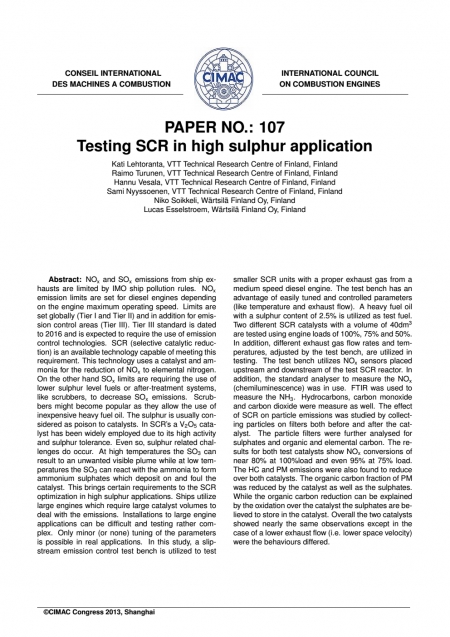
    论文已在中国上海举行的第27届CIMAC大会上发表。论文的版权归CIMAC所有。 NOx and SOx emissions from ship exhausts are limited by IMO ship pollution rules. NO.emission limits are set for diesel engines depending on the engine maximum operating speed. Limits are set globally(Tier I and Tier ll) and in addition for emission control areas(Tier ll). Tier ll standard is dated to 2016 and is expected to require the use of emission control technologies. SCR(selective catalytic reduction) is an available technology capable of meeting this requirement. This technology uses a catalyst and ammonia for the reduction of NOx to elemental nitrogen. On the other hand SOx limits are requiring the use oflower sulphur level fuels or aftetreatment systems, like scrubbers, to decrease SO, emissions. Scrubbers might become popular as they allow the use of inexpensive heavy fuel oil. The sulphur is usually considered as poison to catalysts. In SCR's a V2Os catalyst has been widely employed due to its high activity and sulphur tolerance. Even so, sulphur related challenges do occur. At high temperatures the SO3 can result to an unwanted visible plume while at low temperatures the SO2 can react with the ammonia to form ammonium sulphates which deposit on and foul the catalyst. This brings certain requirements to the SCR optimization in high sulphur applications. Ships utilize large engines which require large catalyst volumes todeal with the emissions. Installations to large engineapplications can be difficult and testing rather complex. Only minor(or none) tuning of the parameters is possible in real applications. In this study,a slip-stream emission control test bench is utilized to test smaller SCR units with a proper exhaust gas from a medium speed diesel engine. The test bench has an advantage of easily tuned and controlled parameters(like temperature and exhaust flow).A heavy fuel oil with a sulphur content of 2.5% is utilized as test fuel.Two different SCR catalysts with a volume of 40dm3are tested using engine loads of 100%,75% and 50%.In addition, different exhaust gas flow rates and temperatures, adjusted by the test bench, are utilized in testing. The test bench utilizes NOx sensors placedupstream anddownstream of the test SCR reactor. In addition, the standard analyser to measure the NOx (chemiluminescence) was in use. FTIR was used to measure the NH3. Hydrocarbons, carbon monoxide and carbon dioxide were measure as well. The effect of SCR on particle emissions was studied by collecting particles on filters both before and after the catalyst. The particle filters were further analysed for sulphates and organic and elemental carbon. The results for both test catalysts show NO, conversions of near 80% at 100% load and even 95% at 75% load.The HC and PM emissions were also found to reduce over both catalysts. The organic carbon fraction of PMwas reduced by the catalyst as well as the sulphates.While the organic carbon reduction can be explained by the oxidation over the catalyst the sulphates are believed to store in the catalyst. Overall the two catalysts showed nearly the same observations except in the case of a lower exhaust flow(i.e. lower space velocity)were the behaviours differed.
    查看